



🏠 Introduction: More Than Just Decoration
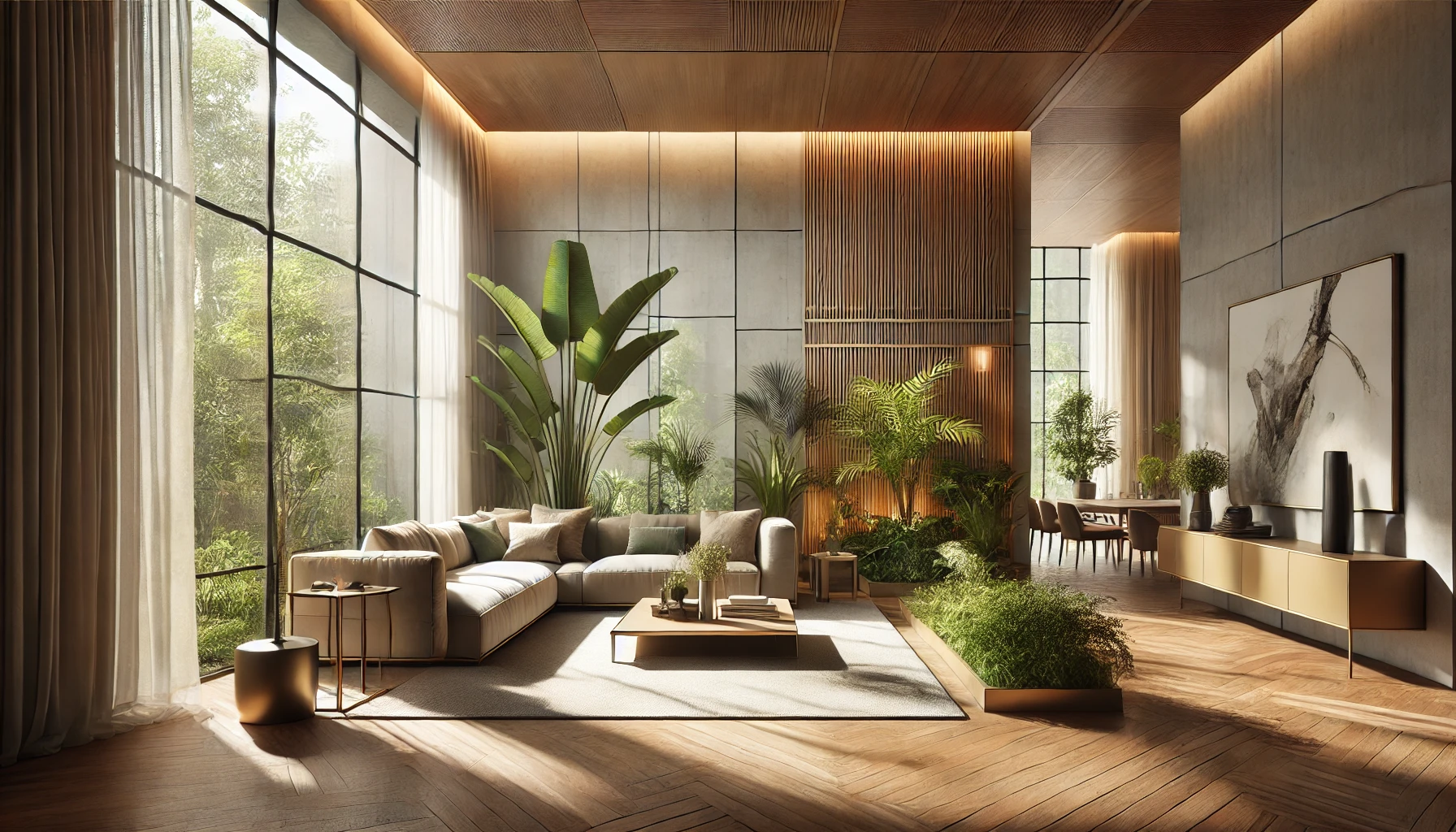
Have you ever walked into a room and immediately felt a sense of peace, or conversely, a sudden wave of restlessness? While we often attribute these feelings to “vibes” or aesthetics, there is a centuries-old discipline that explains exactly why our physical environment has such a profound impact on our internal state. This is the art and science of Feng Shui.
🌬️ What is Feng Shui?
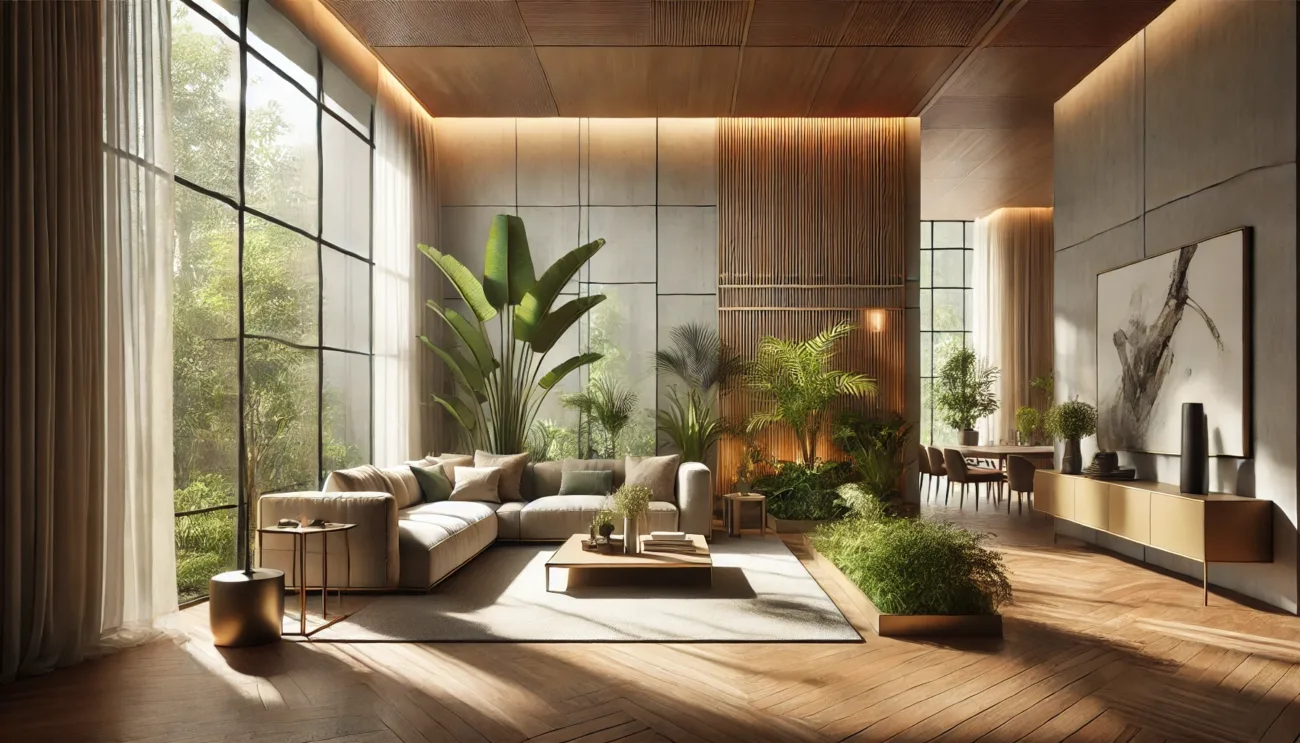
At its most basic level, Feng Shui (pronounced fung shway) is an ancient Chinese practice that dates back over 3,000 years. The literal translation is “Wind” (Feng) and “Water” (Shui). In Chinese culture, wind and water are associated with good health and fortune; thus, Feng Shui is the practice of arranging your surroundings to attract harmony, balance, and prosperity.
It is far more than just “oriental interior design.” It is a complex system of observations that helps us understand how the placement of objects and the layout of our homes affect the flow of energy around us.
✨ The Concept of Qi: The Invisible Thread
At the heart of Feng Shui lies the concept of “Qi” (or Chi). Qi is the vital life force or energy that permeates everything—the trees, the earth, and even the furniture in your living room.
- Optimal Flow: When Qi flows smoothly through your home, it nourishes your personal energy.
- Stagnant Energy: When Qi is blocked by clutter or poor layout, it can lead to feelings of exhaustion, stress, or “stuckness” in life.
🧘 Why it Matters in the Modern World
In an era of high-stress jobs and constant digital noise, our homes have become our ultimate sanctuaries. Feng Shui interior design bridges the gap between form and function, ensuring that your home doesn’t just look good on Instagram, but feels supportive of your goals.
By applying these principles, you can intentionally design spaces that:
- Enhance your mental clarity and focus.
- Improve the quality of your sleep and relaxation.
- Foster deeper connections in your relationships.
- Invite abundance and career growth into your life.
🗺️ The Goal of This Guide
Whether you are a skeptic, a curious beginner, or a design enthusiast, this article serves as your ultimate roadmap. We will move beyond the myths and provide you with a practical, step-by-step framework to transform your living space into a high-vibe environment that works for you, not against you.
☯️ The Core Foundations of Feng Shui
Before you start moving furniture or picking out paint swatches, it is essential to understand the “why” behind the “where.” Feng Shui is not about following arbitrary rules; it is about mastering the balance of nature within a built environment.
Yin and Yang: The Principle of Balance
The concept of Yin and Yang is the foundation of all Chinese philosophy. It represents the idea that all things exist as inseparable and contradictory opposites. In interior design, a space that is too “Yang” can feel chaotic and stressful, while a space that is too “Yin” can feel stagnant and depressing.
| Energy Type | Characteristics | Design Elements | Ideal Rooms |
|---|---|---|---|
| Yin (Passive) | Soft, dark, quiet, cool, feminine. | Plush rugs, velvet, dim lighting, curved lines. | Bedrooms, bathrooms, meditation nooks. |
| Yang (Active) | Bright, hard, loud, warm, masculine. | Marble, bright sunlight, bold colors, straight lines. | Kitchens, home offices, entryways. |
The Design Goal: To achieve a “visual equilibrium” where the energy matches the room’s primary purpose. For example, a living room should be mostly Yang to encourage conversation, but with enough Yin (soft pillows and warm lighting) to remain comfortable.
The Five Elements Theory (Wu Xing)
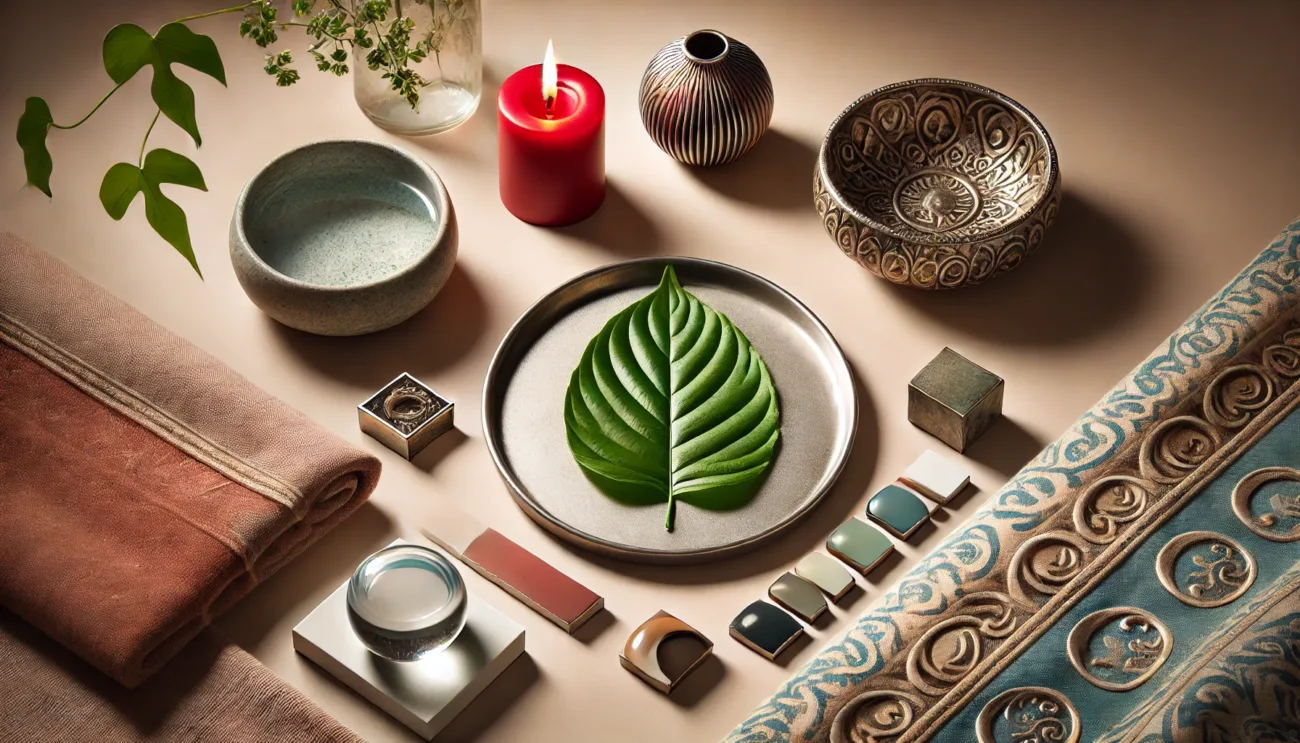
The Five Elements—Wood, Fire, Earth, Metal, and Water—are the building blocks of the universe. In Feng Shui interior design, we use these elements to “cure” energy imbalances and invite specific intentions into a home.
| Element | Represents | Materials & Shapes | Colors |
|---|---|---|---|
| Wood | Growth, Vitality, Healing | Indoor plants, wooden furniture, tall columnar shapes. | Green, Brown |
| Fire | Passion, Fame, High Energy | Candles, fireplaces, triangular shapes, leather. | Red, Orange, Bold Yellow |
| Earth | Stability, Grounding, Self-care | Pottery, crystals, brick, square or flat shapes. | Yellow, Sand, Terracotta |
| Metal | Focus, Clarity, Efficiency | Metallic finishes, iron, round or circular shapes. | White, Grey, Gold, Silver |
| Water | Wisdom, Flow, Abundance | Mirrors, glass, fountains, wavy or fluid shapes. | Blue, Black |
Creating Harmony Through Interaction
Feng Shui practitioners look at how these elements interact. For instance, if you feel your home office is too stressful (too much “Fire”), you can introduce “Water” elements (like a blue rug or a small desk fountain) to extinguish the excess intensity. Conversely, if a room feels “cold” and uninviting, adding “Fire” or “Wood” can breathe life back into the space.
Tip: You don’t need to transform your home into a museum of Chinese artifacts. These elements can be integrated through modern, stylish decor choices—a gold-framed mirror (Metal/Water) or a lush fiddle-leaf fig (Wood) works perfectly in any contemporary setting.
🗺️ The Bagua Map: Your Home’s Energy Blueprint
If Feng Shui is the philosophy, the Bagua Map is the practical GPS. Bagua (literally “eight areas” in Chinese) is an energy map used by practitioners to analyze the layout of a space. It allows you to see how your physical environment mirrors your internal life.
How to Apply the Bagua Map
For modern interior design, the most common way to apply the Bagua is the “Front Door Method.” You don’t need a compass for this; you simply align the bottom of the map with the wall containing your main entrance.
Imagine your home or a specific room divided into a 3×3 grid (like a Tic-Tac-Toe board). As you stand at your front door looking in:
- The bottom row is always aligned with the entrance.
- The middle row represents the heart of the home.
- The top row represents your future and external life.
The 9 Life Areas of the Bagua
Each of the nine squares corresponds to a specific life intention, an element, and a color palette. By enhancing a specific area, you are symbolically “programming” your home to support that goal.
| Bagua Area | Life Aspect | Location (From Entrance) | Element & Colors | Design Enhancements |
|---|---|---|---|---|
| Xun | Wealth & Prosperity | Far Left Corner | Wood (Green, Purple) | Healthy plants, a small fountain, or purple accents. |
| Li | Fame & Reputation | Far Center | Fire (Red, Orange) | Candles, awards, bright lighting, or fireplaces. |
| Kun | Love & Marriage | Far Right Corner | Earth (Pink, Red) | Items in pairs (two candles), soft textures, photos of partners. |
| Zhen | Family & Health | Middle Left | Wood (Green, Blue) | Family photos, heirlooms, botanical prints. |
| Tai Qi | The Center (Self) | Dead Center | Earth (Yellow, Earth tones) | Keep this area clear and grounded; it stabilizes everything else. |
| Dui | Children & Creativity | Middle Right | Metal (White, Pastels) | Art supplies, whimsical decor, metal frames, or round shapes. |
| Gen | Knowledge & Wisdom | Near Left Corner | Earth (Blue, Black) | Bookshelves, a meditation chair, or quiet study space. |
| Kan | Career & Life Path | Near Center | Water (Black, Dark Blue) | Mirrors, glass, or symbols of your professional journey. |
| Qian | Helpful People & Travel | Near Right Corner | Metal (Grey, Silver) | Maps, travel souvenirs, or a “Halt” for gratitude. |
Activating Your Bagua
You don’t need to renovate your entire house at once. Feng Shui is most effective when you focus on one or two areas that need the most attention in your life right now.
Tip: If you live in an oddly shaped apartment with “missing corners” (where the floor plan isn’t a perfect square), don’t panic! You can “cure” a missing area by placing a mirror on the wall that would lead to that space, or by hanging a faceted crystal to reflect energy into that zone.
👑 The “Commanding Position”: Taking Control of Your Space
In Feng Shui, the Commanding Position is the spot in a room where you want to spend the most time. It is the place where you are most in control of your life and energy. When you are in this position, you are literally and metaphorically able to see what is coming toward you.
The Golden Rule of Placement
The fundamental rule is simple: You should be able to see the door from where you are sitting or lying, but you should not be directly in line with it.
| Placement Status | Description | Impact on Energy |
|---|---|---|
| Commanding Position | Diagonal to the door with a solid wall behind you. | Feeling of safety, clarity, and empowerment. |
| The “Coffin Position” | Feet pointing directly out the door while lying in bed. | Energy drains too quickly; causes restlessness. |
| The Vulnerable Position | Your back is to the door (common in poorly placed desks). | Heightened anxiety and a feeling of being “startled.” |
The Three Pillars of the Home
While every piece of furniture matters, Feng Shui prioritizes three specific items that represent your health, your career, and your wealth.
| The “Big Three” | What it Represents | Ideal Placement Strategy |
|---|---|---|
| The Bed | You and your health. | Against a solid wall, diagonal to the door, with space on both sides. |
| The Desk | Your career and success. | Positioned so you can see the door without being “hit” by the direct flow of Qi. |
| The Stove | Your wealth and nourishment. | Ideally placed so the cook isn’t startled by someone entering the kitchen. |
What If You Can’t Move the Furniture?
I understand that modern architecture doesn’t always allow for the “perfect” layout. If your room’s configuration prevents you from achieving the Commanding Position, you can use “cures” to fix the flow.
| Obstacle | The Feng Shui Cure |
|---|---|
| Back to the door at your desk | Place a small mirror on your monitor or desk so you can see the door behind you. |
| Bed in line with the door | Use a footboard, a bench at the end of the bed, or a curtain to create a buffer. |
| Stove facing a wall | Add a reflective backsplash or a mirror behind the stove to see the room behind you. |
Tip: The Commanding Position is all about subconscious safety. When your nervous system knows no one can “sneak up” on you, your brain can shift from survival mode into creative and restful modes.
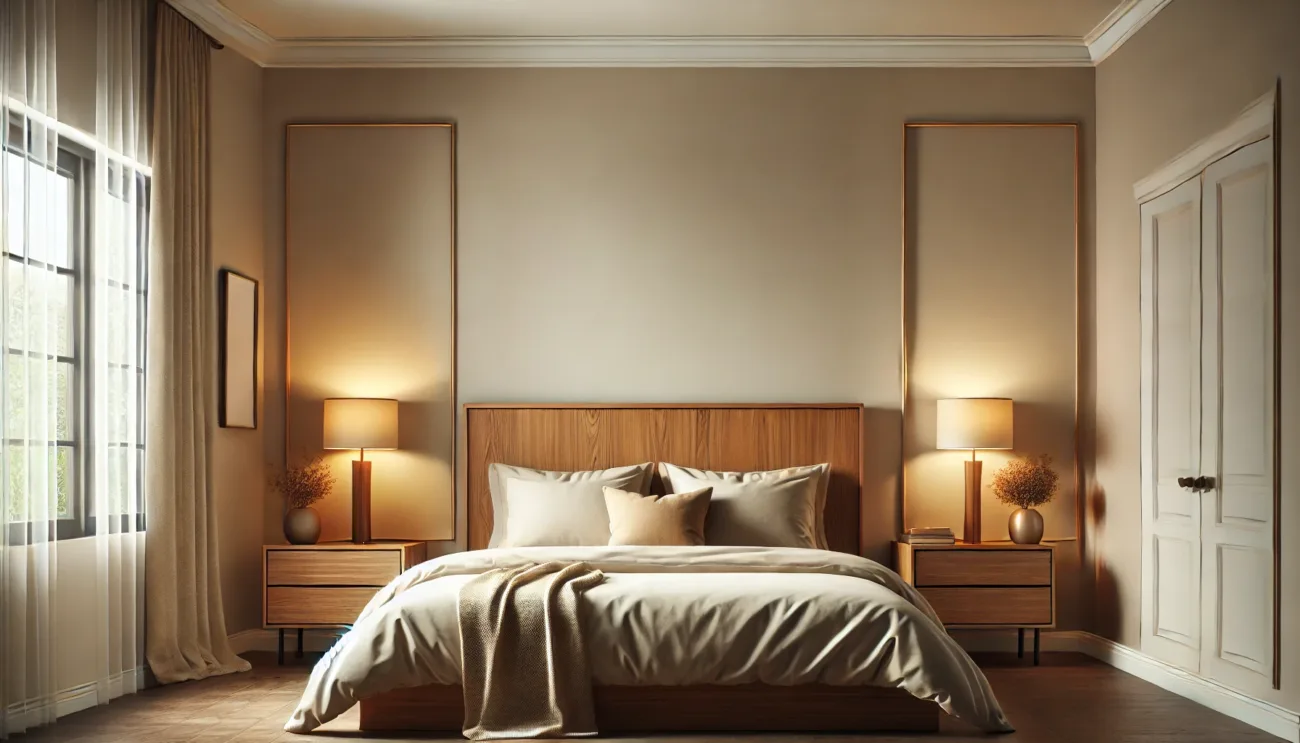
👑 The “Commanding Position”: Taking Control of Your Space
In Feng Shui, the Commanding Position is the spot in a room where you want to spend the most time. It is the place where you are most in control of your life and energy. When you are in this position, you are literally and metaphorically able to see what is coming toward you.
The Golden Rule of Placement
The fundamental rule is simple: You should be able to see the door from where you are sitting or lying, but you should not be directly in line with it.
| Placement Status | Description | Impact on Energy |
|---|---|---|
| Commanding Position | Diagonal to the door with a solid wall behind you. | Feeling of safety, clarity, and empowerment. |
| The “Coffin Position” | Feet pointing directly out the door while lying in bed. | Energy drains too quickly; causes restlessness. |
| The Vulnerable Position | Your back is to the door (common in poorly placed desks). | Heightened anxiety and a feeling of being “startled.” |
The Three Pillars of the Home
While every piece of furniture matters, Feng Shui prioritizes three specific items that represent your health, your career, and your wealth.
| The “Big Three” | What it Represents | Ideal Placement Strategy |
|---|---|---|
| The Bed | You and your health. | Against a solid wall, diagonal to the door, with space on both sides. |
| The Desk | Your career and success. | Positioned so you can see the door without being “hit” by the direct flow of Qi. |
| The Stove | Your wealth and nourishment. | Ideally placed so the cook isn’t startled by someone entering the kitchen. |
What If You Can’t Move the Furniture?
I understand that modern architecture doesn’t always allow for the “perfect” layout. If your room’s configuration prevents you from achieving the Commanding Position, you can use “cures” to fix the flow.
| Obstacle | The Feng Shui Cure |
|---|---|
| Back to the door at your desk | Place a small mirror on your monitor or desk so you can see the door behind you. |
| Bed in line with the door | Use a footboard, a bench at the end of the bed, or a curtain to create a buffer. |
| Stove facing a wall | Add a reflective backsplash or a mirror behind the stove to see the room behind you. |
Tip: The Commanding Position is all about subconscious safety. When your nervous system knows no one can “sneak up” on you, your brain can shift from survival mode into creative and restful modes.
🏠 Room-by-Room Practical Application
Now that you understand the energy map and the power of placement, let’s walk through your home. Each room has a different function, and therefore, requires a different “energy profile” to support your lifestyle.
🚪 The Entryway: The Mouth of Qi
In Feng Shui, the front door is known as the “Mouth of Qi.” It is where all energy, opportunities, and abundance enter your home. If this area is blocked or uninviting, the rest of the house will suffer from “energy malnutrition.”
| Design Objective | Practical Actions |
|---|---|
| Clear the Path | Ensure the door opens fully (no shoes or coats piled behind it). |
| Invite Opportunities | Add a “Welcome” mat and bright lighting to guide energy in. |
| Mirror Placement | Avoid placing a mirror directly facing the door; it “pushes” the energy back out. |
| Define the Space | Even in open-concept homes, use a rug or a small console table to define the “entry.” |
🛏️ The Bedroom: Rest, Recharge, and Romance
The bedroom is the most important room for your personal health. Its energy should be Yin (calm, dark, and soft) to allow your nervous system to fully recover.
- The Headboard: A solid wood or upholstered headboard provides a sense of security and “support” in life. Avoid slatted or metal bars that look like “cages.”
- The “No-Tech” Rule: Remove TVs, computers, and exercise equipment. These represent Yang (active) energy and disrupt sleep.
- Power of Pairs: To invite or nourish a relationship, use symmetry. Think two identical nightstands, two lamps, and two pillows.
- Under-Bed Storage: Keep the space under your bed empty. Storing clutter there symbolizes “sleeping on your problems.”
🛋️ The Living Room: Connection & Community
The living room is a Yang space meant for gathering and conversation. The goal here is to create a sense of “Flow” and “Safety.”
| Design Element | Feng Shui Strategy |
|---|---|
| Seating Arrangement | Arrange furniture in a “U” shape or circular pattern to encourage eye contact. |
| Poison Arrows | Soften sharp corners of furniture (like coffee tables) with plants or fabric to prevent “cutting” energy. |
| Natural Light | Use mirrors to bounce natural light into dark corners, lifting the mood of the room. |
| The Focal Point | Ensure the main seating faces the room’s entrance or a pleasant view rather than just the TV. |
🍳 The Kitchen: The Source of Health & Wealth
In ancient Feng Shui, the kitchen was the measure of a family’s prosperity. Today, it remains a symbol of how well we nourish ourselves.
- The Stove (The Wealth Generator): Keep your stove burners clean and use all of them regularly to keep your “wealth energy” circulating.
- The Fire & Water Clash: Avoid placing the stove (Fire) directly opposite the sink or refrigerator (Water). If they are too close, place a Wood element (like a small plant or a green towel) between them to harmonize the clash.
- Organization: Clear countertops allow Qi to flow freely. A cluttered kitchen often leads to a cluttered mind and poor health choices.
Tip: You don’t need a total renovation. Often, just clearing the entryway of shoes or adding a second nightstand in the bedroom can shift the “feel” of a room overnight.
🔮 Common Feng Shui “Cures” and Enhancements
Even if your home’s architecture isn’t “perfect,” Feng Shui offers a variety of tools to adjust and harmonize the energy flow. These “cures” act as energetic medicine, shifting the vibration of a room without requiring major construction.
🪞 Mirrors: The “Aspirin” of Feng Shui
Mirrors are the most versatile tool in a practitioner’s kit. They can expand, reflect, and circulate Qi.
| Objective | Placement Strategy |
|---|---|
| To Expand Space | Place a mirror in a small, cramped hallway to make it feel wider and less stagnant. |
| To “Double” Wealth | Place a mirror reflecting your dining table to symbolize a doubling of food and abundance. |
| To Correct Layouts | Use a mirror to reflect the door if your desk is in a vulnerable position. |
| ⚠️ Where to Avoid | Never place a mirror directly facing the bed (causes restlessness) or the front door (bounces luck away). |
🌿 Indoor Plants: Living Energy
Plants represent the Wood element—growth, vitality, and healing. They are also excellent for neutralizing “dead” energy in corners.
-
The Best Plants: Look for plants with rounded, soft leaves (like the Money Tree, Jade Plant, or Monstera).
-
What to Avoid: Cacti or plants with sharp, thorny edges are considered “poison arrows” that can create aggressive energy in a home.
-
Healing Power: Use tall plants to fill “dead” corners where energy tends to pool and become stagnant.
🕯️ Lighting: The Power of Yang
Light is the strongest manifestation of Fire energy. It is the most effective way to “lift” the mood of a space.
-
Dark Corners: A dark corner is “dead” energy. Adding a floor lamp there can instantly revitalize the entire room’s Qi.
-
Full Spectrum: Use warm, natural-looking light to mimic the sun, which supports the body’s natural circadian rhythms and mental health.
💎 Crystals and Water Features
-
Faceted Crystals: Hanging a small faceted crystal in a long hallway or a window can break up fast-moving, aggressive Qi and turn it into a gentle “rainbow” of energy.
-
Fountains: Moving water represents the flow of wealth. Place a small fountain near your entryway or in the “Wealth” area of the Bagua to keep prosperity circulating. Tip: Always ensure the water flows toward the center of the house, not out the door.
🧹 The Ultimate Cure: Decluttering
No amount of crystals or mirrors can fix a space that is overwhelmed by clutter. In Feng Shui, clutter is “delayed decisions” and “stagnant energy.”
-
Entryway Clutter: Blocks new opportunities.
-
Bedroom Clutter: Prevents restful sleep and emotional clarity.
-
Kitchen Clutter: Impacts your physical health and financial focus.
Tip: When applying these “cures,” intention is everything. As you place a plant or a mirror, mentally set an intention for what you want that object to achieve (e.g., “This plant will bring vibrant health to my family”).
📱 Modern Feng Shui: Minimalist and Functional
Feng Shui originated in a world of courtyards and wooden pagodas, but its principles are timeless. In our modern era of studio apartments, open-concept lofts, and constant digital connectivity, the challenge is adapting these ancient rules to fit a high-tech, fast-paced lifestyle.
🏙️ Small Spaces and Studio Living
Living in a small apartment doesn’t mean you have “small” energy. In fact, Feng Shui is even more critical in tight quarters where different life areas (sleeping, working, eating) often overlap.
| Challenge | Modern Feng Shui Solution |
|---|---|
| The “One-Room” Dilemma | Use rugs, folding screens, or different lighting levels to “zone” the space. For example, use a rug to define the “living room” area separate from the “bedroom.” |
| Visual Clutter | Minimalism is the best friend of modern Feng Shui. Every object in a small space should be either functional or deeply loved to prevent Qi from getting “stuck.” |
| Hidden Storage | Utilize vertical space, but avoid storing “heavy” items or high-stress items (like tax documents) under the bed. |
🔌 Tech-Harmony: Managing Digital Qi
Electronics generate EMFs (Electromagnetic Fields) and represent extreme Yang energy. If not managed, they can create a “buzzing” restlessness that prevents deep relaxation.
- The Digital Detox Zone: Try to keep the area within 3 feet of your head while sleeping free of phones and chargers.
- Hide the Cords: Tangled wires are the modern equivalent of “poison arrows.” Use cable management boxes to keep energy flow clean and organized.
- Screen Reflections: A large TV screen acts like a dark mirror. If it faces your bed, consider covering it or placing it in a cabinet when not in use to avoid sleep disruption.
🧩 Zoning the Open-Concept Home
Open floor plans are popular for their “flow,” but without boundaries, Qi can move too fast, making the home feel ungrounded.
- Island Hubs: Use kitchen islands or sofas as “anchors” to slow down the energy as it moves through the center of the house.
- Acoustic Feng Shui: Use soft materials (curtains, acoustic panels, rugs) to manage sound. A “noisy” house creates “noisy” energy.
- Color Coding: Use different shades from the Five Elements to define areas. A touch of Earth (yellow/tan) in the center of an open space can help ground the entire floor plan.
🌱 Sustainable Feng Shui: The Eco-Connection
Modern Feng Shui aligns perfectly with the Sustainability movement. Both philosophies believe that we are deeply connected to our environment and that the materials we choose matter.
- Natural Materials: Choosing solid wood, stone, and natural fibers (linen/cotton) instead of synthetics strengthens the Wood and Earth elements in your home.
- Air Quality: Good Feng Shui requires “Good Breath” (Qi). Investing in air-purifying plants or high-quality ventilation is a modern way to ensure healthy Qi circulation.
- Longevity over Trends: Buying furniture that is built to last prevents “disposable energy” from entering your home.
Tip: Modern Feng Shui is not about being “perfect”; it’s about intentionality. If you can’t move your router, simply placing a healthy plant nearby can help “soften” the technical energy and bring a bit of nature back into the digital grid.
🏁 Conclusion: Starting Your Journey
Feng Shui is not a rigid set of superstitions or a “one-time fix” for your home. Instead, it is a living, breathing practice—a continuous dialogue between you and the space you inhabit. By intentionally designing your environment, you are essentially creating a physical vision board for the life you want to lead.
The “Progress Over Perfection” Mindset
Many people feel overwhelmed when they first learn about the Bagua Map or the Five Elements. The secret to successful Feng Shui is to start small. You don’t need to renovate your kitchen or buy all new furniture to see a shift in your energy.
| The “First Step” Roadmap | Actionable Task | Expected Energy Shift |
|---|---|---|
| Step 1: The Entryway | Clear all shoes and clutter from behind the front door. | You will feel more “open” to new opportunities and less stressed when returning home. |
| Step 2: The Commanding Position | Adjust your bed or desk so you can see the door. | A decrease in subconscious anxiety and an increase in focus/safety. |
| Step 3: The Bedroom Sanctuary | Remove one piece of technology (like a laptop or TV). | Deeper, more restorative sleep and better emotional connection. |
| Step 4: The Declutter | Clear one single surface (like a kitchen counter or coffee table). | Immediate mental clarity and a sense of control. |
🧭 Your Home as a Reflection of Your Soul
As you move through this journey, pay attention to how you feel after making a change. Feng Shui is highly personal; if a specific “cure” doesn’t feel right to you aesthetically, it won’t work energetically. The most powerful Feng Shui is the one that makes you feel empowered, relaxed, and inspired.
Remember: Your home should be the place that recharges you so that you can go out and conquer the world. When your space is in harmony, your life often follows suit.
Thought: You are the most important element in your home. By taking the time to care for your surroundings, you are ultimately taking the time to care for yourself. Happy decorating!